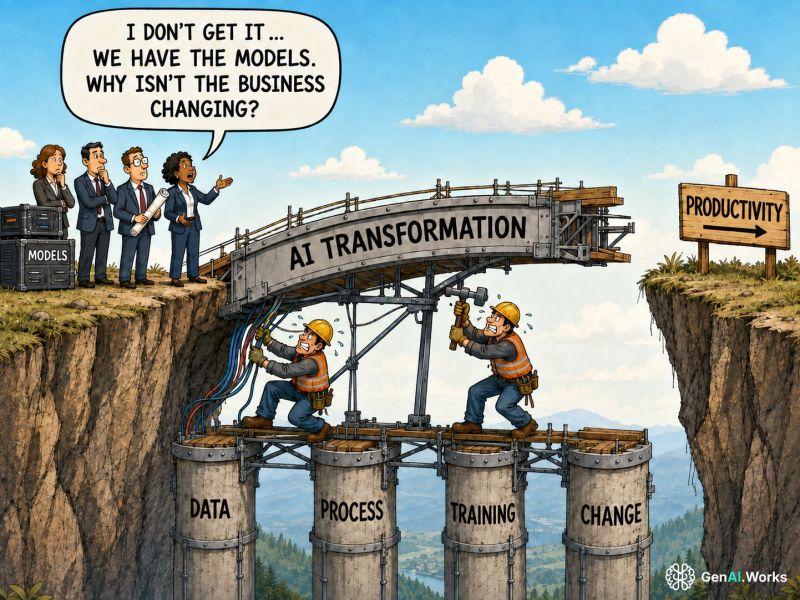
"We have the models. Why isn't the business changing?"
Notice who's asking. It's never the two under the bridge with the hammer. Buying model access is a procurement job. Clean data, written-down processes, trained people and an organisation that works differently take years, and that work usually lands on a couple of engineers on top of their day job.
“You can buy the models. You can't buy the bridge.”
It costs more than the licence
If leadership wants AI (artificial intelligence) to change the business, they need to know where they're heading and fund the boring bits to get there. And they need to still care once the demo glow wears off.
Morale gets underrated. Say "AI" and "efficiency" in the same all-hands and watch people polish their CVs. The fix is telling business people they'll be the ones running the AI-assisted version of their job, then actually training them for it. Whoever's done payroll for ten years knows the weird edge cases; the model doesn't. Sit them next to your engineers early and the automation gets better, and nobody's training their own replacement.
Stop defending the old job
I see good engineers burn more energy arguing about what AI can't do than learning what it can. Clicking through the same portal screens every release isn't a skill worth protecting. Hand it over and go learn something new.
Start where mistakes are cheap
If I were kicking this off in a DevOps team tomorrow, I wouldn't go near production. I'd start in test and non-prod, where there's an endless pile of drudgery: environment refreshes, flaky pipelines, orphaned resources, patching boxes nobody owns. A bad call there costs you a rebuild, not a post-incident review.
That's where you build trust and guardrails cheaply. Give the agent least-privilege credentials. Run it read-only at first, so it can look and report but not touch. Then let it do things you can roll back. Anything irreversible waits for a human to approve it. Every action goes into an audit log, and the blast radius stays at one environment or one service at a time. None of that is new; it's how we've always rolled out automation. Once it's boring in non-prod, you move it into production a piece at a time.
A real one from today
My Google storage was at about 98% of 100 GB (gigabytes). I asked my AI assistant to shrink my biggest Google Photos videos. It runs on its own cloud desktop, so it wasn't chewing through my home internet quota.
It downloaded the 10 largest and trial-encoded them at five levels with ffmpeg, the free open-source converter, using H.264 and HEVC (High Efficiency Video Coding, aka H.265) at different quality settings and resolutions. On the first five videos (816 MB, megabytes), H.264 (L0) gave 429 MB, 47% saved. Light HEVC (L1): 410 MB, 50%. HEVC at CRF (Constant Rate Factor) 28, same 720p (L2): 235 MB, 71%. 540p (L3): 77 MB, 91%. 480p (L4): 37 MB, 95%.
I eyeballed a side-by-side frame, picked L2 and said "replace one at a time". For each video it uploaded the new copy, checked the date taken matched, re-added it to its shared family albums, moved the original to the bin, then permanently deleted just that one item. Never "empty bin". One video, an old Storage saver copy, actually got bigger under L2, so it skipped that one by itself.
Nine videos went from 1,351 MB to 432 MB, about 919 MB back (68%), with dates and locations preserved. A second batch of 20 was running while I wrote this. My effort was a handful of taps: pick a level, say "one at a time", say "clear the trash", and ask it to stop playing the videos on screen because it was distracting. Feedback like that is a guardrail too.
A trial that touched nothing, real numbers, me choosing, a reversible step, a check, and only then the delete. That's exactly the sequence I'd want from an agent in non-prod. It's also why I had time to write this instead of babysitting uploads.
What I'd do on Monday
- Write down the most tedious jobs in your non-prod environments.
- Pick one. Run an agent on it read-only and check its homework for a week.
- Give it least-privilege access, an audit log and an approval step before it changes anything.
- Grab someone from the business whose work it touches and build it with them.
Right, I'm off to check on batch two.